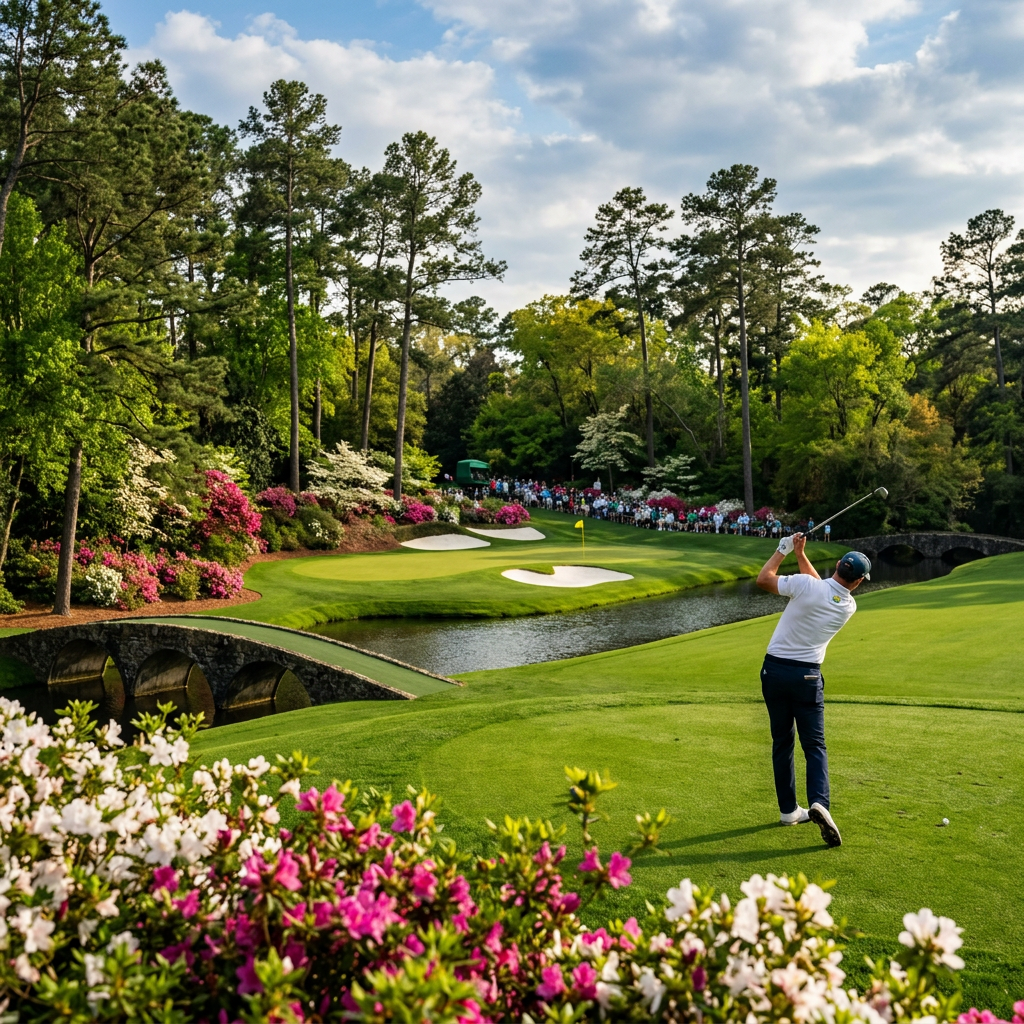
Today, April 11, 2026, the pines of Augusta National whispered a familiar tune: Saturday at the Masters is where legacies are forged and leads are liquidated. As we witness the 'Moving Day' of the 90th edition of this storied championship, the atmosphere is electric, charged by a leaderboard that features a collision between established icons and the game’s brightest young architects.
Augusta National remains the ultimate test of psychological endurance and tactical flexibility. This year, the course is playing particularly firm, with the sub-air systems working overtime to keep the greens at a blistering 13.5 on the Stimpmeter. For the serious golfer, observing the Saturday charge provides a masterclass in risk management—a lesson in when to fire at tucked pins and when to accept a twenty-foot par putt as a victory.
The Strategic Pivot: Navigating the 'New' 13th
The 13th hole, 'Azalea,' continues to be the strategic epicenter of the back nine. While the lengthening of the tee box a few seasons ago was designed to restore the integrity of the dogleg, the 2026 field has adapted with a variety of approaches. Today, we saw the leaders split into two camps: the aggressive long-hitters trying to turn the corner with a high draw, and the conservative tacticians who opted for a 3-wood and a precision wedge.
Scottie Scheffler, chasing his third Green Jacket, demonstrated why he remains the gold standard for ball-striking. On the 13th today, he executed a peeling fade that held against the slope, leaving himself a manageable 4-iron into the heart of the green. His ability to control the spin rate in this afternoon’s rising breeze has been the difference-maker. For those watching at home looking to replicate this level of control, focusing on a stable lower body through the hitting zone is paramount.
The Amen Corner Gauntlet
Amen Corner—holes 11, 12, and 13—has lived up to its reputation as a scorecard killer this Saturday. The 11th hole, 'White Heather,' played as the most difficult hole on the course for the early starters. With the pin tucked in the back-left quadrant near the pond, several contenders found themselves bailed out into the right-side 'second cut,' only to face a terrifying downhill chip toward the water.
Ludvig Åberg, the young Swede who has rapidly ascended to the top of the world rankings, showed remarkable poise through this stretch. His strategy was one of extreme discipline: aiming for the 'fat' of the green on 11 and 12, and relying on his world-class lag putting to avoid the dreaded three-putt. In a tournament where the greens are this fast, the ability to judge speed from 40 feet is often more valuable than the ability to stick a wedge to six feet.
The Putter’s Paradox on the 15th
The par-5 15th, 'Firethorn,' provided the most dramatic swings of the afternoon. With the wind swirling through the valley, the decision to go for the green in two has become a calculated gamble rather than a foregone conclusion.
We saw Rory McIlroy, still chasing that elusive career Grand Slam, take a bold line over the water today. While the patrons held their collective breath, Rory’s towering 5-iron cleared the hazard by a mere yard. It was a moment of 'all or nothing' golf that defines his career. However, the subsequent eagle attempt—a sliding 12-footer—rimmed out, highlighting the cruel reality of Augusta’s surfaces. For the amateur player, the lesson here is clear: the shot into the green is only half the battle; the real work begins once you reach the putting surface.
Condition Report: Firm, Fast, and Fickle
Course conditions on this Saturday, April 11, have been described by the field as 'borderline.' The moisture levels in the turf are being monitored meticulously, but the afternoon sun has baked the fairways to a point where drives are rolling out 30 to 40 yards. This increases the importance of 'course mapping'—knowing exactly where the ball will finish, not just where it will land.
Many of the leaders have commented on the difficulty of holding the greens on the shorter par 4s, like the 7th and 17th. Players who are unable to generate high-launch, high-spin numbers are finding it nearly impossible to stop the ball near the hole. This is where modern equipment and ball technology are being pushed to their absolute limits.
The Leaderboard Dynamics
As we head into the final hours of Moving Day, the leaderboard is a tapestry of storylines. We have the relentless consistency of Scheffler, the raw power of McIlroy, and the unflappable calm of Åberg. The separation we see on a Saturday at the Masters is rarely about physical talent alone; it is about the capacity to stay present. Augusta punishes the 'future-thinker'—the player who starts imagining the green jacket ceremony while standing on the 14th tee.
Looking Ahead to Sunday’s Finale
The stage is set for a historic Sunday. The forecast calls for calmer winds but even higher temperatures, which will likely push the greens to their absolute limit. To win tomorrow, a player will need more than just a hot putter; they will need a strategic blueprint that accounts for every slope, every gust of wind, and every psychological trap that Augusta National has spent 90 years perfecting.
For the serious student of the game, tomorrow isn't just about watching golf; it's about watching a chess match played at 120 miles per hour. Keep a close eye on the approach shots into the par-3 16th—historically, this is where the tournament is won or lost in the final round.


